It is impossible to talk about any sector these days without bringing up AI. The food and beverage industry lags when it comes to AI because companies are still trying to figure out how to best use the technology. It is more costly to shut down plants and halt production for weeks to build out space for robots. But that doesn’t mean AI still doesn’t have its benefits.
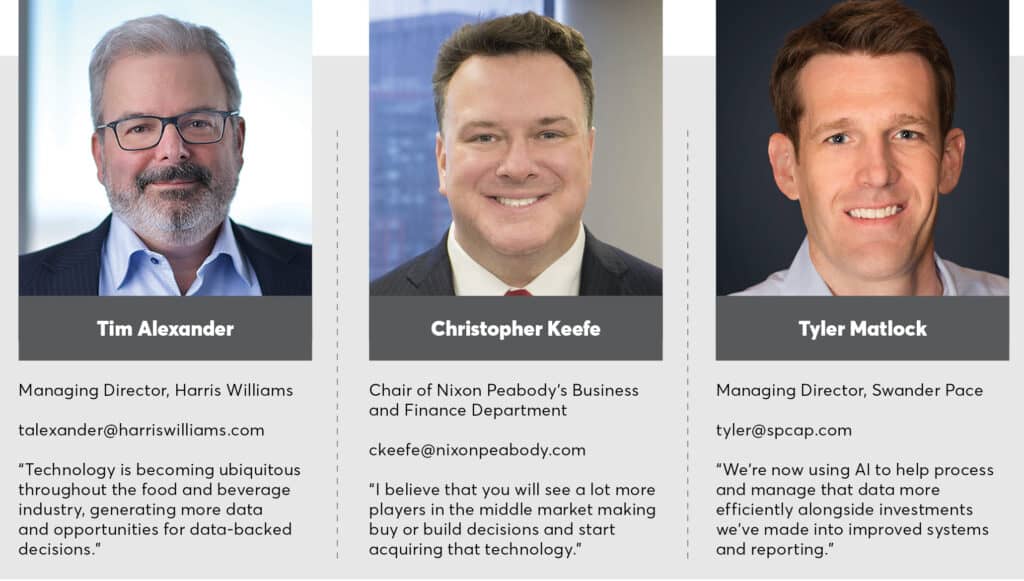
“Technology is becoming ubiquitous throughout the food and beverage industry, generating more data and opportunities for data-backed decisions,” says Harris Williams Managing Director Tim Alexander. “With AI, food and beverage businesses can make data mining and analytics more effective to drive better decisions and greater efficiencies across a wide range of operations.” The list of operations includes supply chain and inventory management, minimizing food waste gathering and consumer feedback on social media.
AI in the food and beverage industry is estimated at $9.68 billion and is expected to reach $48.99 billion by 2029, growing at a CAGR of 38.3 percent, according to Research and Markets. “By implementing AI tools, companies can also improve productivity and fuel growth without needing to increase headcount. This is particularly important in a tight labor environment where recruiting and retaining talent is more challenging,” adds Alexander.
Deals in this space are scarce and practically nonexistent. One that stands out came in February when Level Equity acquired a majority stake in food retail technology provider Upshop from Prairie Capital. Tampa, Fla.-based Upshop offers AI-powered software that helps grocery and convenience store chains increase sales, reduce waste and streamline labor. The target’s technology assists with inventory forecasting and ordering, while making employees’ tasks easier and more productive. Some of Upshop’s customers include Kroger (NYSE: KR) and Wegmans.
Level Equity is a middle-market technology-focused investment firm that is based in New York. Some of its other investments include event management software company Blackthorn; sales analytics provider Clari; and cybersecurity company Hoxhunt.
Dealmakers do not expect a rush of acquisitions anytime soon, at least not this year, but they say an M&A wave is on the horizon similar to what happened with robotics and automation a few years ago. “We haven’t seen a revolution in M&A with respect to that yet, but that’s coming,” says Christopher Keefe, the chair of Nixon Peabody’s business and finance department. “I think when you get a couple of more years down range and some of the solutions being developed now by venture-backed companies and others become a little bit more mature, I believe that you will see a lot more players in the middle market making buy or build decisions and start acquiring that technology.”
“I think food companies are still trying to figure out the applications of artificial intelligence to our food system and the best ways to leverage the technologies. I personally think we are years away from food companies really beginning to acquire true AI startups,” adds Cascadia Managing Director Scott Porter.
While food and beverage companies are waiting for the right time for acquisitions, the larger players are using AI to make new products. For example, in September 2023, Coca-Cola (NYSE: KO) launched a limited-edition soft drink called Coca‑Cola Y3000. Coke used AI to create the can for the beverage.
Let’s not forget about PE firms because they are getting involved in AI too. Swander Pace Capital Managing Director Tyler Matlock says his firm’s portfolio companies are gradually implementing AI but are in no rush to expand its uses.
“We’re definitely staying on top of it at our portfolio companies and trying to stay ahead of the curve,” Matlock says. “Leveraging data to make resource allocation decisions has always been critical for any business. We’re now using AI to help process and manage that data more efficiently alongside investments we’ve made into improved systems and reporting. We’re a little more cautious right now on the use of AI externally. We want to have authentic conversations between our brands and their respective customers and end consumers. So, we’re taking a more gradual approach on how best to leverage that as a tool for our businesses.”
Swander Pace, with offices in San Francisco and Bedminster, N.J., is a consumer-focused private equity firm that invests in the food and beverage, health and wellness and household sectors. Some of its investments include Café Valley, a manufacturer of croissants, cakes and muffins; Purely Elizabeth, a maker of granola, oatmeal and pancake mixes; and bakery products supplier St-Méthode Bakery.
Covington & Burling Partner Patrick Manchester says acquisitions are beneficial in the food tech space and now is the time to start developing relationships with other companies. “Food companies can gain an edge over competitors by bringing key technologies in-house, as acquisitions can be more efficient than developing technologies internally, conducting smart due diligence, and using creative strategies to bridge valuation gaps and smooth the pathway to regulatory clearance,” he says. “We also expect many food companies will engage in collaborations and joint ventures as a prelude to acquisitions or as a path to development of new technologies like quantum computing. These initial deals allow food companies to pilot and conduct diligence on the technology with a lower upfront commitment.”
Now we just wait for the robots to rise.