After clicking on a story, use the back arrow in your browser to return to your search results. Use phrases "in quotes" or the tools below to better filter your results.
A Market on Ice: Alcohol M&A Cools as Shifting Tastes Bite
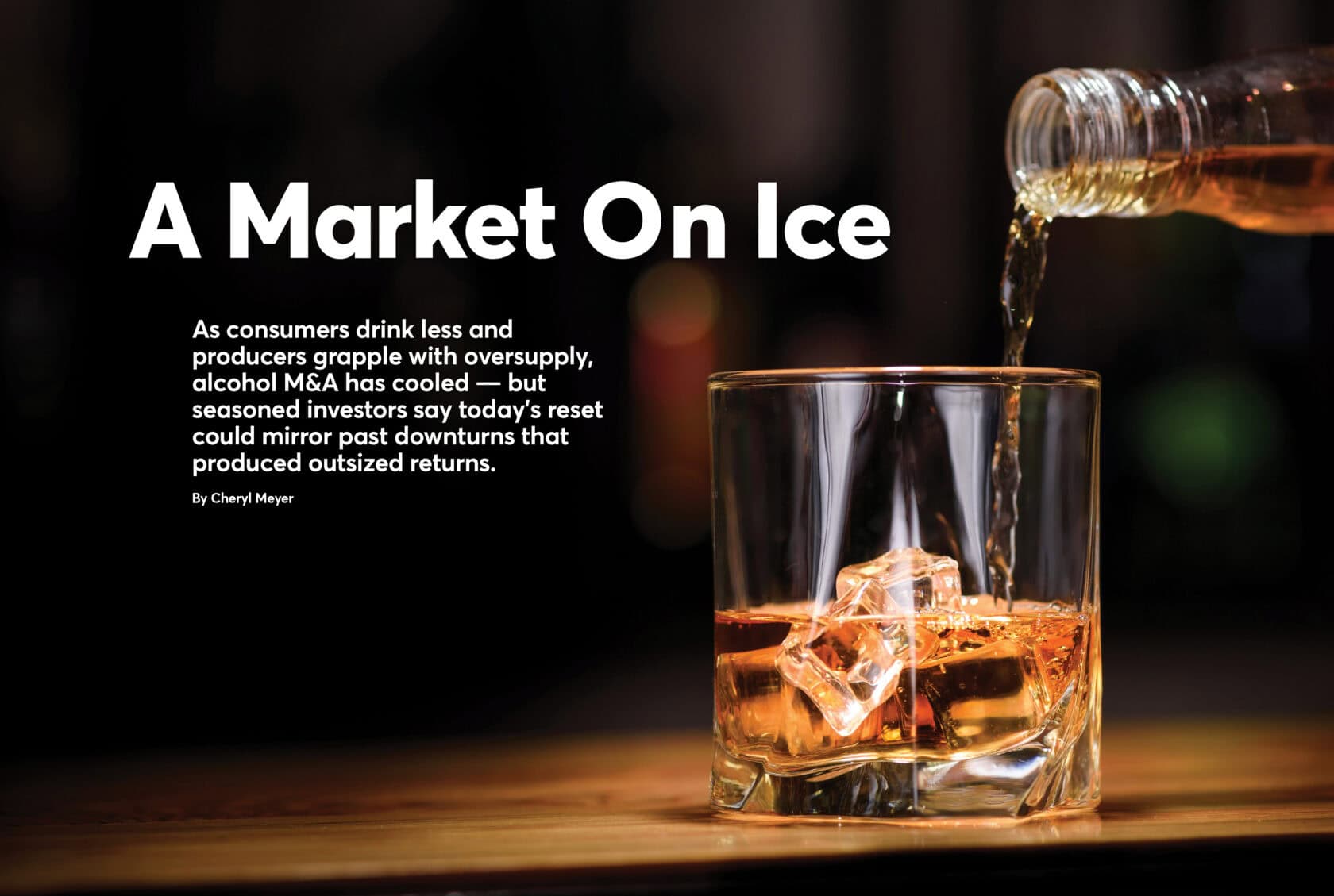
As consumers drink less and producers grapple with oversupply, alcohol M&A has cooled — but seasoned investors say today’s reset could mirror past downturns that produced outsized returns.
For as long as humans have lived on this earth, they have loved to drink – alcohol, that is. Whether it’s moonshine, a malbec or a Michelob beer, booze is rooted deep in this world’s culture. Towns across America have embraced local taverns, restaurants, brew pubs and wine bars. Drinking is often the epitome of socialization, a time when friends, colleagues or couples get together to unwind.
Eagle Rock Distributing Co. operates as a major beverage distributor in Colorado.
March 23, 2026
But the alcohol industry is enduring a sober reset. The wine and craft beer sectors are struggling; a glut of aging whiskey sits in barrels; and people are drinking less or not at all. The health-conscious younger generations like Gen Z often prefer ready-to-drink (RTD) concoctions in aluminum cans vs. a regional lager or chardonnay. Americans’ alcohol budgets have also shrunk with inflation, and the government tariffs have wreaked havoc on an already demoralized sector.
All of these downbeat reports – generated by Gallup and others – have solidified the worrisome mood for dealmakers, especially private equity firms. Buyers’ level of uncertainty as the industry sways – coupled with a longer timeline required for some alcohol-related investments – has slowed M&A activity. Cash-heavy strategics completed over 80 percent of the deals in 2025, reported Chicago investment bank Capstone Partners, in its Beverage Market Update last September. Meanwhile, distressed wineries and distilleries fight to stay afloat due to reduced consumer demand and oversupply. Many of these operations won’t survive.
“Buyers are looking at things from a predatory standpoint, and they want an extremely good deal to pull the trigger – or it has to be something really rare and special,” says Erik McLaughlin, the CEO of wine-focused M&A advisory firm Metis, in southeastern Washington. “The confidence that investors have has really been rocked.”
But seriously, what’s happening here? Is the alcohol sector in trouble? Are Americans going to stop drinking and spawn a severe M&A drought? The answer, according to PE veterans and others, is a resounding “No.” The industry, they explain, is merely stomaching a rough-and-tumble retune – both from a cyclical and generational standpoint and smart investors can still find amazing deals. They just need to know where to look and ask the right questions.
“This is like real estate in 2008 and 2009, where you can find depressed valuations, but extreme value,” says Mike Solow, co-founder and partner of 99 Proof Partners, a Dallas-based PE firm focused on middle-market alcohol beverage deals. The firm currently has about 500 investors and is managing seven equity transactions. In January, 99 Proof invested in Texas distillery Still Austin Whiskey Co.
“At a macro level, bourbon is not going anywhere. Vodka is not going anywhere. Tequila is all the rage right now. Don’t fall for the click bait,” Solow adds.
San Francisco-based Cordillera Investment Partners buys whiskey from distilleries, ages it for years and then sells it to various brands. In 2024, the firm raised $62 million for its Whiskey Opportunities Fund, signifying the firm’s confidence in the spirit. “The headlines are all about a generation that doesn’t drink and is health conscious – and that is true, but that is really on the margin,” states Chris Heller, Cordillera’s co-founder and co-managing partner. “We’ve never really done any M&A or bought a brand, but for the first time we’re looking at some interesting opportunities.”
Last September, Chicago-based InvestBev Group, a PE outlet focused on the adult beverage industry, also “reaffirmed its commitment to bourbon and the wider alcohol beverage industry.” The firm manages numerous investments across the alcohol spectrum, including JuneShine, an RTD-cocktail maker and Ten to One, an ultra-premium Caribbean rum.
The Reset Reality
Despite such optimism, the industry faces challenges. There are too many wineries, distilleries and craft beer makers at a time when consumer preferences are shifting. Producers and investors stress over the surplus of wine, beer and some spirits. In 2025, U.S. wine sales dropped 4.9 percent and beer/cider/seltzer dropped 3.7 percent, reported NielsenIQ in its 2025 Year in Review.
“The industry is in a state of flux and correction,” summarizes Alan Pawlowski, president of M&A advisory firm Pace Management, in Buffalo, N.Y. “We’ve never had such a glut of non-sellable sell-side deals in 20 years of doing this. It’s almost impossible to find buyers.” The craft beer sector has seen defaults, turnarounds and failures, and craft distilled spirits have also struggled, he says.
“Buyers are looking at things from a predatory standpoint, and they want an extremely good deal to pull the trigger.”
For PE firms, finding worthy targets is tough, with countless distressed properties begging for help and with competition from strategics. “Within alcoholic beverages, you have the cash-rich established legacy players that are hungry for growth,” notes Chicago-based Jake Steslicki, vice president with investment bank PMCF.
Still, investors of all stripes continue to discover deals. In 2025, Garage Beer, a successful independent beer brand in Ohio, received a strategic growth investment from New York PE firm Durational Capital Management. And in December, Washington state’s Wyckoff family announced it had purchased the Ste. Michelle Wine Estates near Seattle. New York PE firm Sycamore Partners previously owned the large winery.
Producers have also merged. In Massachusetts, Hog Island Beer Company acquired Mayflower Brewing Company last year. The combined entity, now known as Triton Beverage Group, also bought Cape Cod Beer last year.
“Beer, particularly at the wholesaler tier, remains fragmented and needs to be consolidated,” notes New York-based Townsend Ziebold, managing director of Arlington Capital Advisors, an M&A advisory firm. Two years ago, Arlington advised RTD cocktail brand BuzzBallz on its sale to global spirits company Sazerac Company.
“We’re expecting a strong recovery and at some point, the dam is going to break with private equity.”
Traditional alcohol categories also face competition from RTDs, THC/hemp drinks and the low- or no-alcohol category. RTD popularity has surged, and the drinks now comprise over 12 percent of all off-premise alcohol sales, reports NielsenIQ. These RTDs generated $13.6 billion in revenue in 2025. “It’s not a fad,” Ziebold says.
Meanwhile, wine sales have plummeted. “Wine has a demographic problem,” Ziebold notes. Baby Boomers, who tend to drink more than other groups, kept the wine industry afloat for decades. “For everyone under age 60, wine is their third choice,” reports Silicon Valley Bank in its “State of the U.S. Wine Industry 2026” report. “For those above 60, wine is the top choice. That is the cliff we are walking off today, and why this change seems to be moving so quickly.”
Unlike Boomers, younger generations crave variety and aren’t loyal to one type of alcoholic beverage.
“The days of people like me are neanderthal,” quips hospitality attorney Louis Terminello, a managing partner at the Miami office of law firm Greenspoon Marder. “I want my Wild Turkey 101 on the rocks. I don’t apologize for it. That’s my drink.” Terminello, who chairs the firm’s hospitality, alcohol and leisure industry group, represents retail clients on their sales or acquisitions, and says alcohol sales are down.
The Long Pour
After a lackluster 2025, dealmakers predict M&A activity will improve with the backlog of distressed businesses. But things remain bumpy as the industry right-sizes its oversupply, consolidation continues and weak producers fade away, sadly nursing their evening drinks. RTDs and certain spirits may generate most of the M&A activity.
“It will be very painful for the industry for the next few years, even if we get consumption to stabilize,” McLaughlin says.
“Beer, particularly at the wholesaler tier, remains fragmented and needs to be consolidated.”
Townsend Ziebold, Managing Director, Arlington Capital Advisors [email protected]
Investors need to dive in with a backbone or retreat. “If you’re not comfortable with this environment, you may as well be on the sidelines for the next three years,” states Robert Marks, director at Capstone Partners. “We’re expecting a strong recovery and at some point, the dam is going to break with private equity. There’s so much dry powder sitting on the sidelines.”