The $500 billion pension’s rise from last place to the top of its league tables wasn’t driven by deal selection or market timing, but by structural changes in governance, asset mix and deployment discipline.

For years, the California Public Employees’ Retirement System tried to fix its private-markets problem by adjusting pacing, shifting managers and debating valuations. What ultimately pulled the country’s largest pension from the bottom of its peer group to the top wasn’t a clever market call.
It was a wholesale change in process and governance.
The turnaround reflects a deliberate reset built around three moves: reallocating capital away from large buyouts toward growth equity and venture capital, rethinking how and when the fund uses co-investments, and committing to deploy capital steadily across market cycles rather than pulling back during periods of stress.
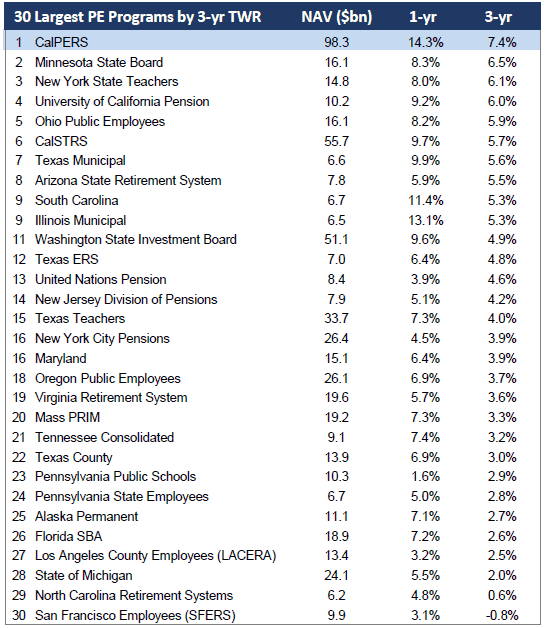
CalPERS’ $98 billion private-equity portfolio delivered annualized returns of 7.4 percent in the three years ended June 2025 and 14.2 percent for the preceding 12 months, ranking first in both categories among the 30 largest U.S. public pension systems, according to data presented to the board last week. As recently as December 2022, the fund ranked last in that same peer group.
At the heart of the shift was a governance rethink that gave the investment team more flexibility to shape portfolios and exert influence over managers. In 2024, the board approved raising CalPERS’ PE allocation to 17 percent from 13 percent. Within that allocation, however, the fund sharply reduced its reliance on traditional buyouts, which now account for 58 percent of private-capital commitments, down from 91 percent three years earlier.
“Growth and venture don’t just have higher returns on average, they also have some diversification from buyout,” CalPERS PE head Anton Orlich told the board.
Where CalPERS continues to invest in buyouts, it has shifted away from large-cap funds toward smaller, middle-market managers. Middle-market strategies now represent 57 percent of buyout commitments, up from 40 percent in fiscal 2022.
The change is partly about returns and partly about control. In smaller funds, CalPERS’ capital represents a larger share of the vehicle, increasing its ability to influence governance, transparency and portfolio decisions.
Supporting that approach, CalPERS revised its concentration limits to allow the pension to take stakes of up to 35 percent of a fund, up from 25 percent previously. Board leaders have also framed the shift as a way to reduce reputational risk tied to large-cap buyouts, which they say are more likely to involve workforce reductions, corporate restructurings and other negative publicity.
“On average, where would something be more likely to show up as a problem? I would imagine it would be with buyout,” Orlich acknowledged. “We dramatically diversified the portfolio away from those transactions.”
In buyouts, CalPERS says it addresses these concerns through manager diligence and more active participation on LP advisory committees, where its increased exposure to middle-market funds gives it greater influence.
“We are looking out for these kinds of investments that hurt the workforce,” says board president Theresa Taylor. “We have some managers that we had really high confidence in, and they have proven not to be so reliable, and these are larger names.”
Perhaps the most consequential change has been CalPERS’ formal commitment to steady deployment across market cycles, a direct response to the fund’s infamous “lost decade” of lackluster PE investing.
After committing heavily to private capital in 2006 and 2007, CalPERS retreated following the financial crisis. CalPERS sat out much of a historically strong period for the asset class, forfeiting an estimated $11 billion to $18 billion in returns.
Today, the fund commits roughly $15.5 billion annually regardless of market conditions, avoiding sharp vintage concentration and resisting the instinct to pull back when conditions deteriorate.
The overhaul extends to co-investments, an area where CalPERS has taken a contrarian stance.
Rather than maximizing co-investment volume to reduce fees, the fund has prioritized selectivity. Orlich told the board that for much of the past three decades, CalPERS’ co-investments underperformed its fund commitments, even after accounting for lower fees. Over the past three years, that pattern has reversed, with co-investments now outperforming underlying fund portfolios on a gross basis.
The fund now deploys roughly 40 percent of its annual PE commitment budget through co-investments, capturing an estimated $400 million in fee and carry savings for every $1 billion deployed. Orlich says that’s a potentially $25 billion savings over a decade at current levels.
Orlich says that many LPs treat co-investments as a volume exercise, an automatic add-on designed to reduce fees and boost net returns. He says that CalPERS’ experience suggests that approach can backfire.
The pension found that its co-investments underperformed its fund commitments for most of the past three decades, even after accounting for fee and carried-interest savings. Orlich says the culprit was adverse selection: pursuing co-investment opportunities simply because they were available, rather than because they were compelling.
CalPERS reversed course by reframing co-investments as a selection tool rather than a quota. Instead of co-investing with every manager, the fund now concentrates on a smaller set of relationships and participates selectively in deals where it has the highest conviction.
“We start with the foundation of manager selection and invest in what we think are the best funds,” Orlich says. “Then we selectively participate in co-investments where we think we are doubling down on the best opportunities that are provided by those funds.”