Artificial intelligence is no longer a differentiator in tech-enabled services M&A — it has become a core underwriting consideration.

As dealmakers move deeper into 2026, buyers are shifting their focus from AI adoption to execution risk, governance and commercial defensibility, factors that are reshaping how targets are valued and how diligence is conducted across the middle market.
New findings from Equiteq’s Global Buyers 2026 Report highlight the growing caution beneath continued enthusiasm for AI-driven assets. Roughly 73% of private equity respondents and 60% of strategic acquirers cited valuation risk as a primary concern, while nearly half pointed to uncertainty around return on investment. More than half of buyers also expressed anxiety about technological obsolescence — a signal that the market is moving from experimentation toward accountability.
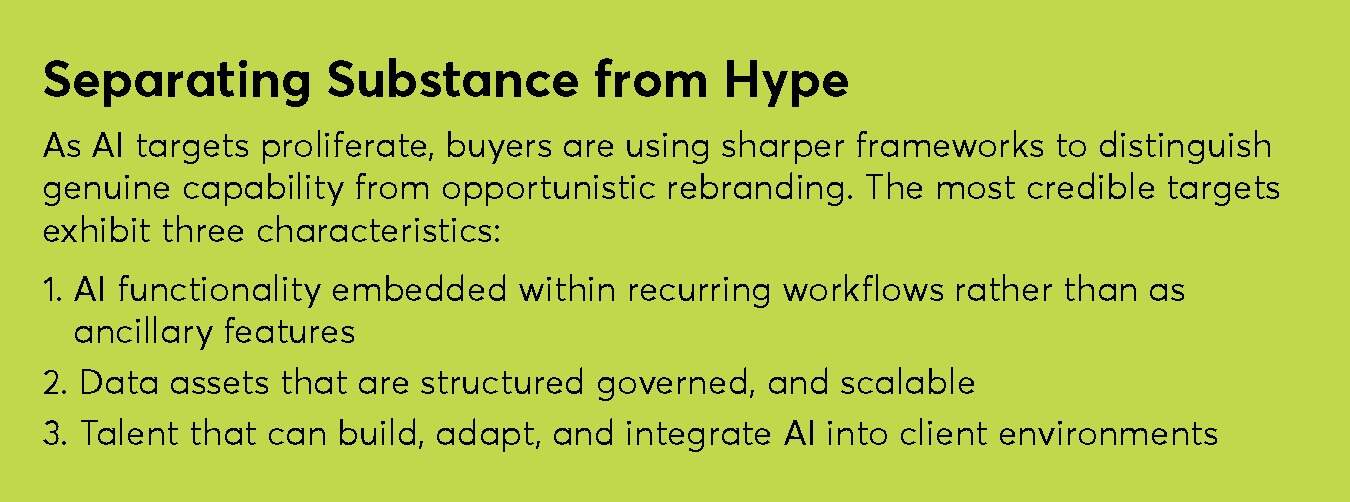
That recalibration consistently shows up in live deal processes. Buyers continue to pursue platform companies and add-ons positioned around scalable AI capabilities, but premium pricing is increasingly tied to operational maturity. Targets that earn premium consideration typically show four things. They embed AI in core delivery and recurring workflows, maintain structured and well-governed data that scales, protect defensible intellectual property and accelerators that enhance speed, efficiency or insight and integrate safely into enterprise client environments.
Definitions have tightened. Pure-play AI services can be small and expensive, and some providers have rebranded as “AI-enabled” without substantive capability. Financial thresholds used by financial sponsors still emphasize fundamentals and durability:
- 12% revenue growth
- 14% EBITDA margins
- 37% gross margins
- 80% retention rates
Deal multiples show an average range of between 4.8x and 12.6x EBITDA, depending on the target’s growth rate — a range that has remained consistent over the last four years. In competitive auctions, indications for differentiated AI-heavy assets can still push beyond 30x EBITDA depending on growth profiles and strategic positioning, but diligence teams are digging deeper into governance frameworks, structured data environments and commercialization pathways.
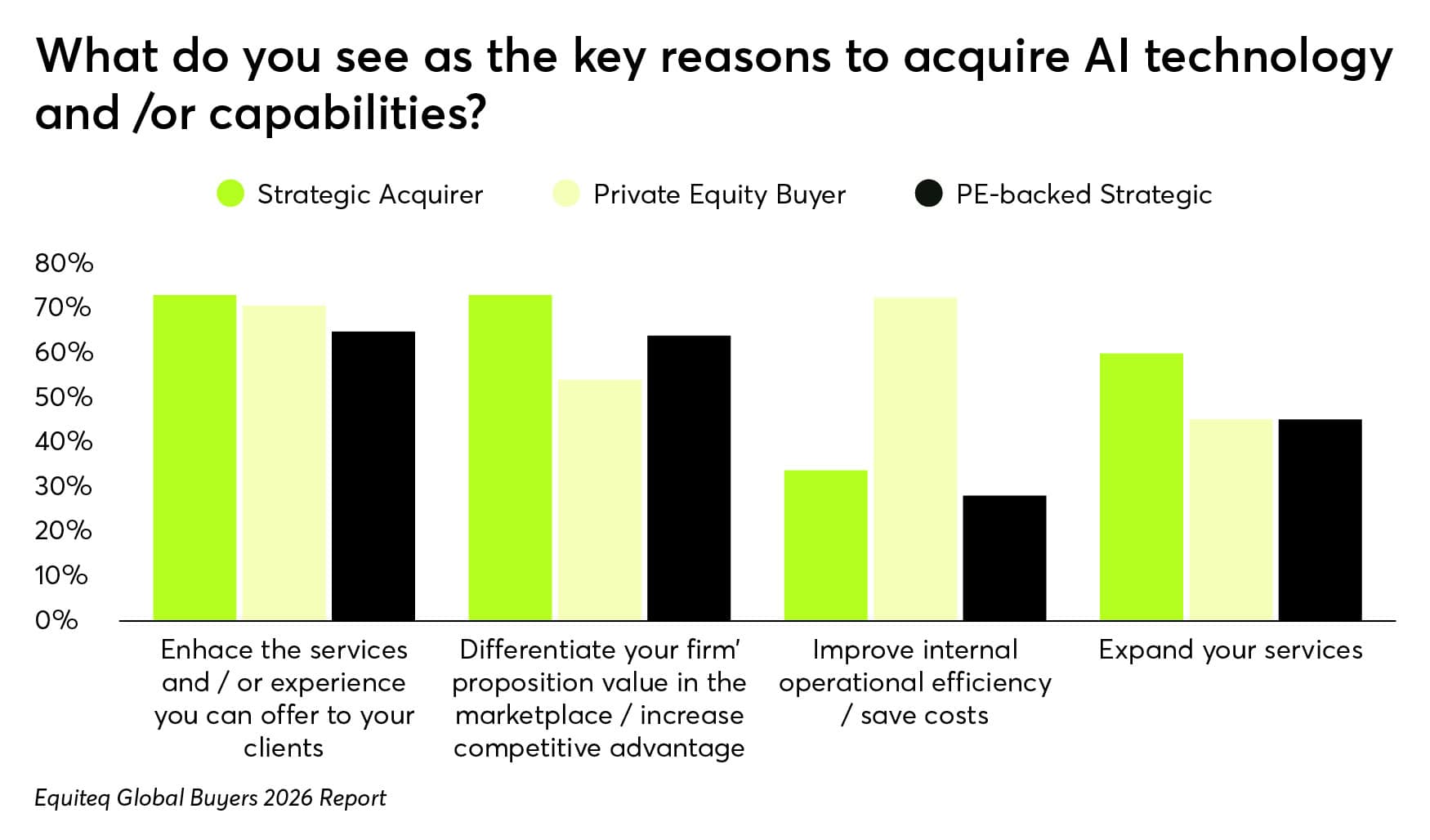
Buyers have moved from asking “Does this company use AI?” to “How defensible is its strategy?” They are placing greater emphasis on specificity, scalability and measurable outcomes.
Equiteq’s survey underscores how central AI has become to strategic planning. Approximately 94% of corporate respondents described AI as important or very important to their business, up from 84% last year, while 82% of private equity investors reported similar priorities. As a result, diligence frameworks are expanding to evaluate not just technology stacks but also talent, data governance and the ability to operationalize AI within client environments.
Scarcity continues to drive competitive tension. Targets offering proprietary data assets, mission-critical cloud or cybersecurity capabilities, or advanced advisory expertise in strategy and operations are attracting strong interest from both sponsors and strategics.
By contrast, businesses centered on generic automation or chatbot-style features are facing increasing skepticism. Buyers are weighing AI readiness alongside traditional fundamentals such as data management strength, revenue durability and margin profile. The result is a more balanced underwriting framework that blends innovation with disciplined financial analysis.
For many middle-market firms, AI is emerging as a core determinant of competitive positioning rather than an incremental upgrade. Automation is viewed less as a cost-cutting tool and more as a lever for scalability, delivery consistency and margin expansion — particularly as diligence cycles lengthen and buyers demand clearer proof of execution.
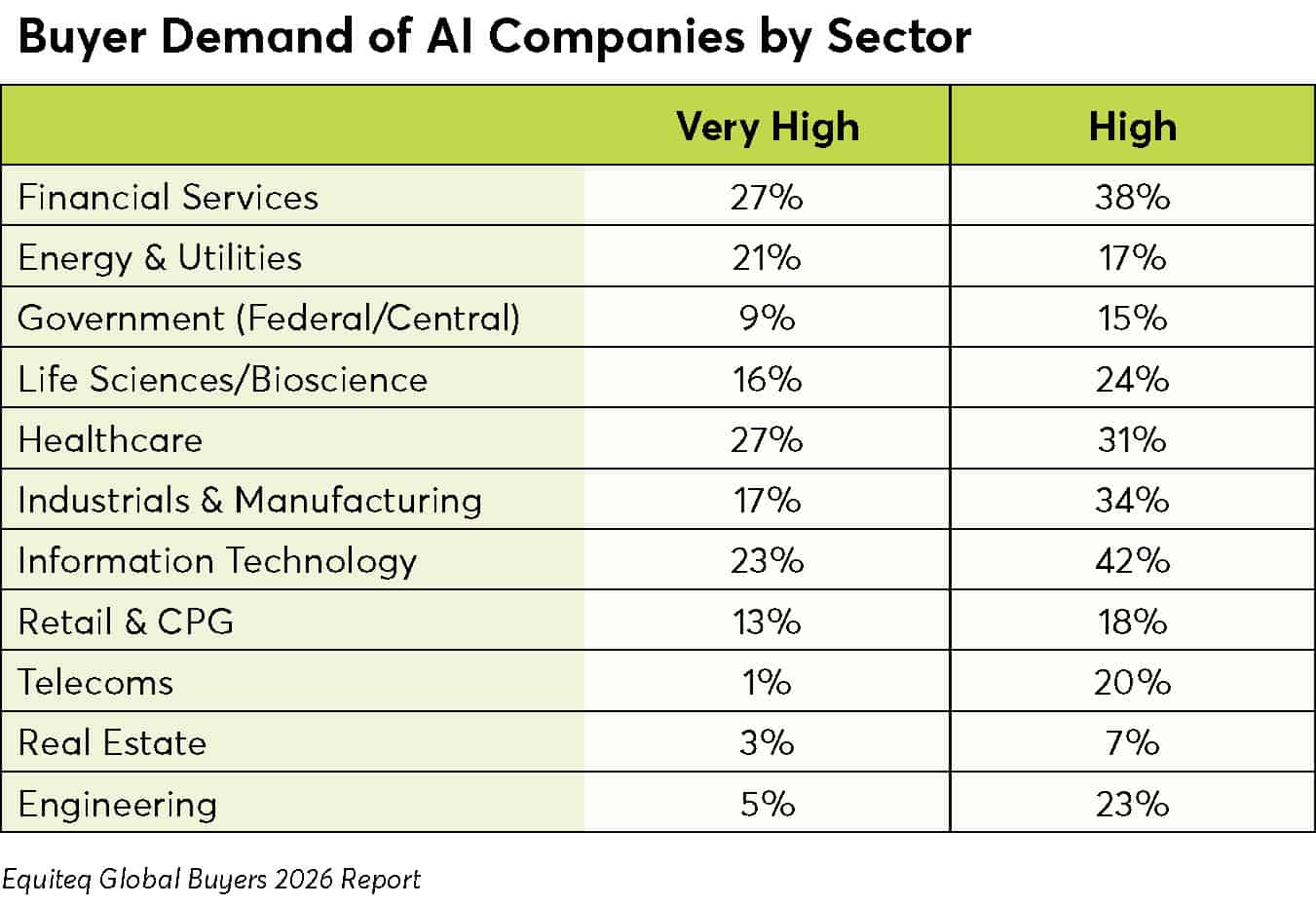
Amid heightened interest in AI-themed sellers, data management quality remains a central differentiator. Sellers who can articulate how AI strengthens intellectual property, integrates into client workflows and future-proofs operating models are standing out in crowded processes.
As digital transformation continues to reshape the M&A landscape, artificial intelligence is transitioning from a source of hype to a baseline expectation. For buyers, the focus is increasingly on underwriting discipline and defensibility. For sellers, the message is clear: the highest valuations are likely to go to organizations that treat AI not as positioning, but as an operating principle embedded across the business.