
Artificial intelligence (AI) has rapidly moved from experimentation to embedded infrastructure in mergers and acquisitions (M&A). According to AI in M&A Dealmaking 2026: A Benchmark Study, produced by SS&C Intralinks in partnership with Reuters Professional, the industry has reached a decisive inflection point. Based on a global survey of 400 senior M&A professionals across private equity, corporate, advisory, banking, venture capital and legal sectors, the research shows that while AI adoption is accelerating, organizations are still catching up when it comes to oversight, governance and risk management.
The findings highlight both the scale of AI’s impact and the complexity it introduces, creating a clear mandate for dealmakers to rethink not just how they use AI, but how they control it.
So what does this mean for middle-market deal teams navigating increasing competition, tighter timelines and growing data complexity?
AI is No Longer Optional — It’s Operational
The data confirms what many deal professionals are already experiencing: AI has crossed the adoption threshold. Nearly half (49 percent) of respondents report that AI is fully integrated across most stages of the deal life cycle, with another 41 percent citing partial integration. Only a small minority remain in pilot mode.

This widespread adoption is not confined to a single function. AI is now being deployed across sourcing, screening, diligence, execution and portfolio management. In practice, this means deal teams are increasingly relying on AI to automate document review, analyze financials, surface risks and accelerate workflows that were once manual and time-intensive.
For middle-market firms, this shift is particularly significant. As larger firms scale AI capabilities, the competitive gap can widen quickly. The ability to move faster, analyze more data and uncover insights earlier in the deal process is becoming table stakes.
Efficiency Gains are Real — But Still Evolving
One of the clearest benefits of AI adoption is measurable time savings. Nowhere is this more evident than in due diligence, where more than one-third of dealmakers report saving up to 30 percent of valuable time. Across the broader deal life cycle, the majority of respondents report at least double-digit efficiency gains.
Most deal teams surveyed shared they’re operating with multiple AI tools simultaneously. In fact, more than half of respondents report using between three and five AI solutions, with many using even more.
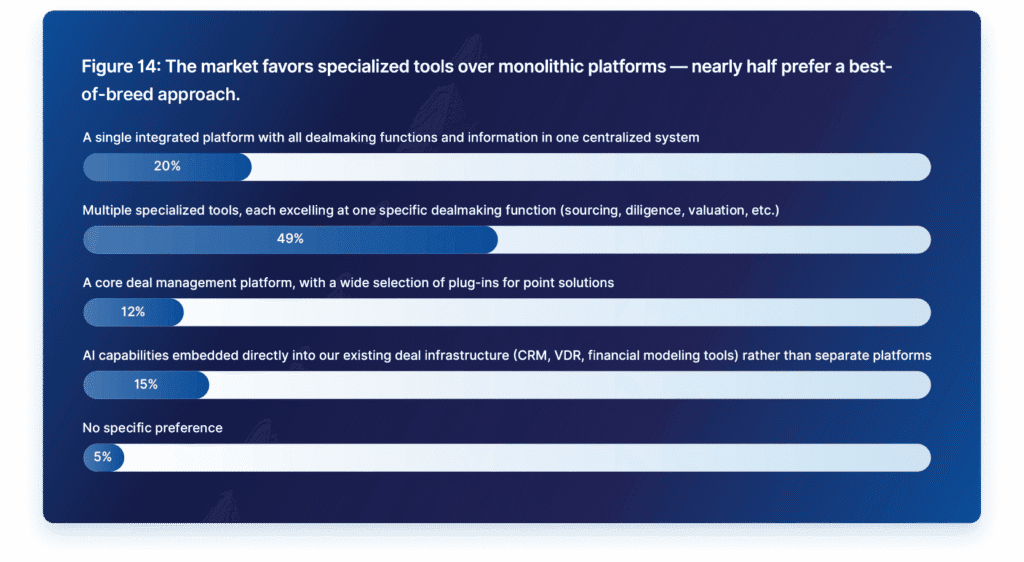
This reflects a growing preference for specialized tools that excel at specific tasks — whether that’s legal review, financial analysis or market intelligence — rather than one-size-fits-all systems.
However, the research also reveals an important nuance: while AI tools are highly effective at accelerating mundane tasks, they have not yet fully transformed end-to-end workflows. In other words, the next phase of value creation will come not from adding more tools, but from integrating them into connected, intelligent deal processes.
Risk is Rising Alongside Adoption
As AI usage expands, so does the risk profile. A striking 80 percent of dealmakers report experiencing AI-related security incidents or near misses in the past 12 months. These incidents range from access control lapses — where sensitive data is exposed unintentionally — to hallucinated outputs that can lead to flawed analysis. For deal teams handling confidential transaction data, the implications are significant.

At the same time, although governance frameworks are largely in place (94 percent of respondents report that their organization follows at least one formal AI policy or compliance framework), gaps remain between policy and practice. This disconnect highlights that responsible AI implementation depends equally on formal policies and on having the right security, infrastructure and controlled data environments in place.
Adoption is Accelerating, Alongside Increased Scrutiny
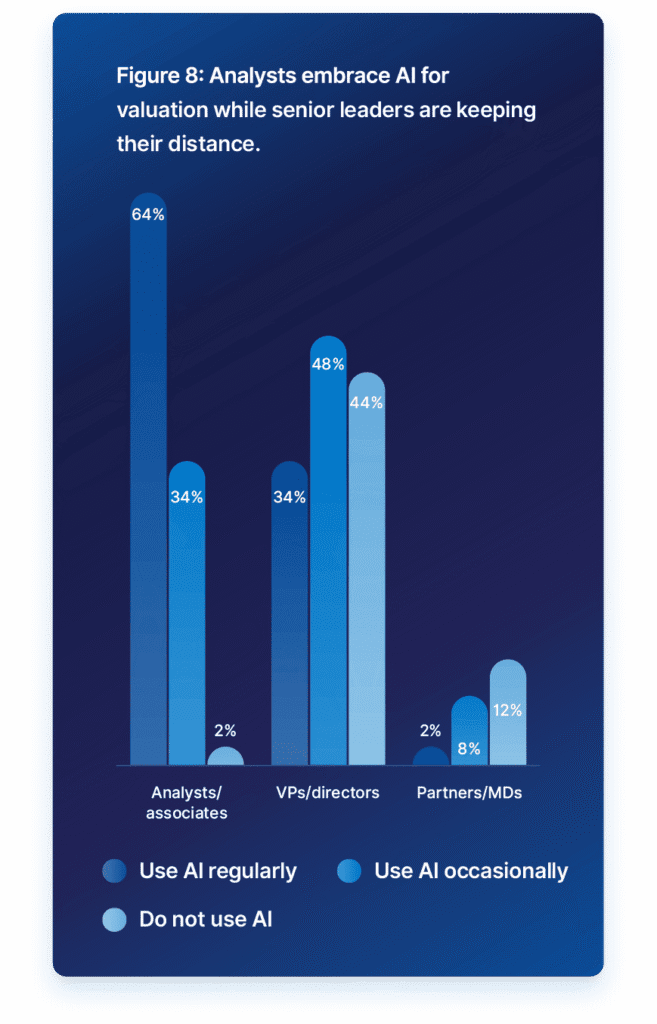
Interestingly, the research shows that as AI adoption accelerates, so does increased scrutiny. More than half of respondents report growing pushback from senior leadership, driven by concerns around accuracy, explainability and fiduciary risk.
This reflects a broader dynamic within deal teams: junior professionals are often leading AI adoption, while senior decision-makers — who carry ultimate accountability — remain cautious.
Bridging this gap will be essential. Firms that invest in AI literacy at the leadership level and create transparency around how AI-generated outputs are produced, will be better positioned to build trust and scale adoption effectively.
The Future of Dealmaking Will Be Defined by Balance
Looking ahead, AI is only going to play a bigger role in how deals get done. Many dealmakers are already thinking about what comes next, including more advanced capabilities like autonomous workflows and predictive deal analytics.
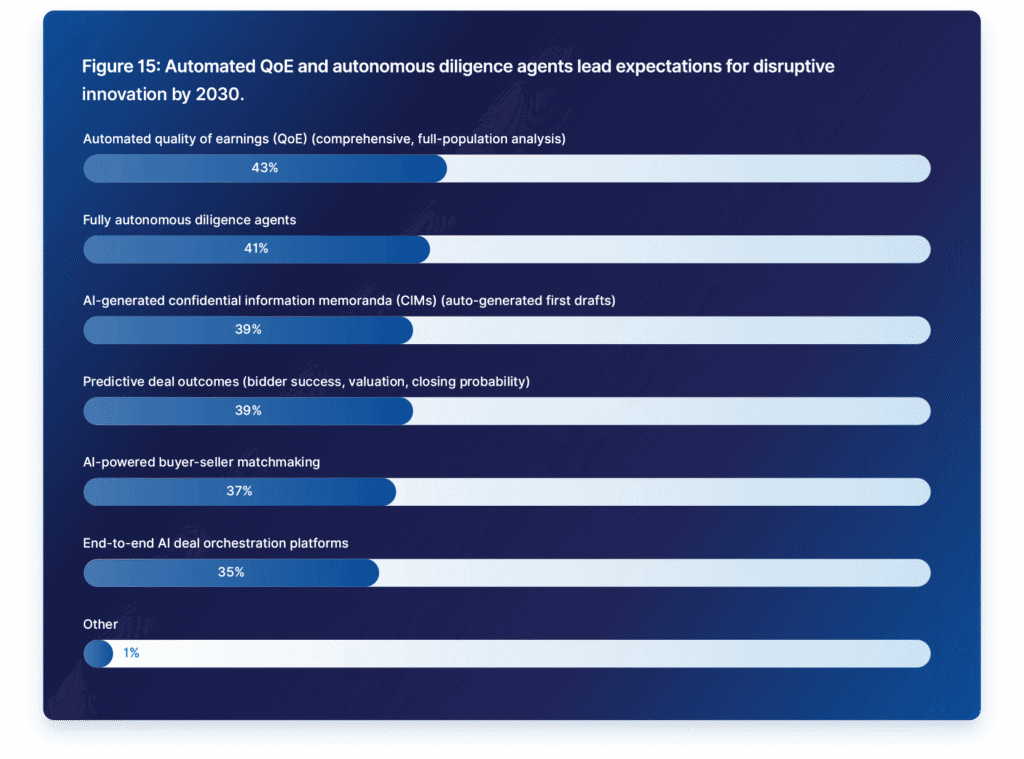
At the same time, there is a growing recognition that simply adding more AI tools is not the answer, and that success will depend on how well those tools are governed, integrated and aligned with a firm’s risk framework.
For middle-market deal teams, this presents a strategic opportunity. By adopting AI thoughtfully — prioritizing security, integration and human oversight — firms can compete more effectively while avoiding the pitfalls of unchecked adoption.
For the full findings, request a copy of AI in M&A Dealmaking 2026: A Benchmark Study by clicking on the box at the top of the story.