The middle market is not driving global dealmaking the way it once did. After accounting for the majority of worldwide middle-market M&A activity just four years ago, the segment has steadily ceded ground to large-cap and megadeals as higher interest rates, tougher financing conditions and prolonged valuation gaps reshape sponsor behavior. The shift underscores how smaller and mid-sized companies are facing a more selective and uneven buyer landscape. Here’s our monthly analysis.
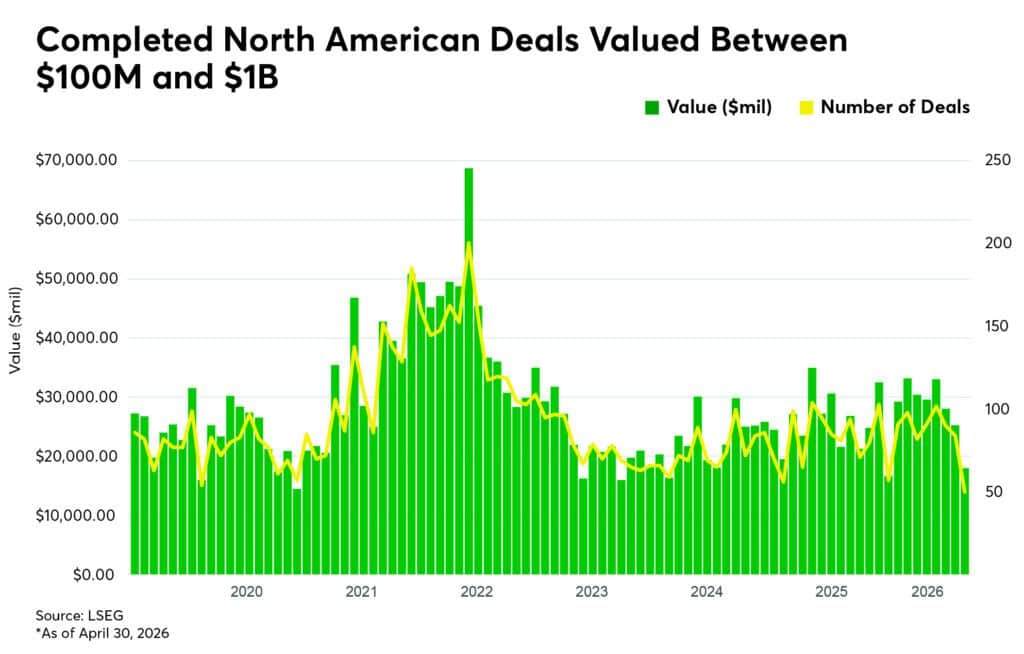
Middle-market dealmaking slowed sharply in April, with transaction value falling to just $18 billion across 50 deals, according to data from LSEG. These are transactions valued between $100 million and $1 billion.

The monthly total marked the weakest volume since August of last year. It’s also one of the lightest monthly deal counts in recent memory, underscoring the uneven nature of the broader M&A recovery.

Globally, M&A activity has rebounded more forcefully.

Deal volumes rose 13 percent YoY to $319 billion in the first quarter of 2026. Middle-market activity, by contrast, increased just 9 percent, extending a five-year trend of underperformance relative to the broader market.

In the first quarter of 2022, middle market deals accounted for 57 percent of worldwide middle-market deal activity. By the first quarter of 2026, that figure had fallen to 27 percent, reflecting a pullback in sponsor-backed acquisitions and a growing concentration of activity in large-cap and megadeals.

The shift highlights how the post-pandemic private-equity boom has given way to a more selective environment dominated by fewer, larger transactions. While overall M&A values has grown steadily in 2026, much of the rebound has been driven by blockbuster deals rather than a broad reopening of the middle market.

Advisers and investors point to several factors weighing simultaneously on middle-market activity. Among the reasons cited include:

  • Higher financing costs
  • Tariffs
  • Geopolitical uncertainty
  • Slower exits
  • Widening valuation gaps

All are throwing a wet blanket over middle-market dealmaking. Financing markets that once supported aggressive leverage multiples remain more restrained, particularly for cyclical businesses and companies with uneven earnings profiles.

“The April data reflects the economic and geopolitical uncertainty that sponsors are trying to navigate,” says Pat Lanigan, a partner at Chicago-based buyout firm Twin Bridge Capital Partners. “With the war in the Middle East surpassing the two-month mark in April, the energy shock and supply-chain effects have become tangible issues that North American companies are being forced to face and solve for. For the buyer, the underwriting becomes more difficult as factors such as input costs and supply-chain logistics in the short- and medium-term are uncertain.”

Pat Lanigan, Twin Bridge

Lanigan said middle-market dealmaking has increasingly centered on a narrow group of favored sectors, particularly technology M&A, as buyers move beyond the brief period of AI-related disruption and uncertainty.

“In these unpredictable and unprecedented times, we’ve seen consistent deployment of capital into sectors that are relatively insulated from the noise, including healthcare services and residential services,” Lanigan says. “Overall, deal volume has mimicked the choppiness of the macro environment and will likely continue to do so until there is more clarity and resolution.”

Brey Jones, who recently launched advisory firm Thirdpath, said deals that are getting completed are taking longer to close.

“One of the biggest changes we are seeing is that underwriting discipline has returned to private markets,” says Jones, who co-founded StepStone Group. “Compared to a few years ago, buyers are spending far more time conducting diligence around downside resilience, value creation plans and exit timing and options. That is a healthier dynamic for the industry over the long term.”

Brey Jones, Thirdpath

Jones said the latest M&A figures are unlikely to prove temporary.

“The April data reinforces that this is becoming a much more selective market,” Jones says. “Capital is still available, but it is concentrating around businesses with durable cash flows, pricing power and real strategic relevance. The era where liquidity alone could drive outcomes is largely behind us.”

Sector Winners / Losers

Four sectors are showing YoY growth through April: Consumer Staples (+303 percent), Financials (+49 percent), Media and Entertainment (+14 percent) and Technology (+8 percent). Driving these positive numbers for deals that closed in April included:

  • CVB Financial’s (Nasdaq: CVBF) $797 million purchase of Heritage Commerce, a California Bay Area banking deal
  • E&J Gallo Winery‘s $775 million purchase of Four Roses Distillery from Kirin Holdings, bringing ownership of the bourbon maker back to the U.S. after 83 years with the Japanese.
  • Toronto-based Clairvest Group‘s $546 million acquisition of MGM Northfield Park, the Ohio “racino” business carved out of MGM Resorts International. It’s Clairvest’s 14th land gaming deal.

Seven sectors show year-on-year declines with Real Estate, Energy and Industrial showing the steepest drops. Collectively, these three sectors are off 22 percent with volume dropping from $35.4 million thru April 2025 to $27.6 million for the same period this year.

IPOs

IPOs continued to show a strong comeback, although it wouldn’t have taken much for a YoY comparison to last April. Last month had 10 firms go public versus none in 2025.

Leading the way was Kailera Therapeutics (Nasdaq: KLRA), a late clinical-stage biotech focused on GLP-1 therapies for obesity care. Kailera raised $625 million in its debut.

In another hot area, AEVEX Corp. (NYSE: AVEX) raised $368 million, confirming investors’ interest in the aerospace & defense industry. The firm specializes in autonomous uncrewed systems, AI-enabled mission software, and intelligence, surveillance, and reconnaissance (ISR) solutions.

YTD IPO figures show 2026 up 214 percent in amounts raised as the market eclipsed $10 billion by the end of April compared to just $3.2 billion in 2026.

League Tables

After one-third of the season, Goldman Sachs (NYSE: GS) sits atop the league tables for middle market deals, closing 21 transactions for a value of about $11 billion. Piper Sandler (NYSE: PIPR), Jefferies (NYSE: JEF), JPMorgan (NYSE: JPM) and Morgan Stanley (NYSE: MS) round out the top five. Internal moves by Stifel/KBW like selling its independent advisory arm and investment in its venture banking unit, seem to be paying off, as it’s currently sitting in sixth place with 13 deals for $4.2 billion. Last year at this time it was mired in 19th place having executed on only seven deals.

On the IPO side, JPMorgan leads the pack with 12 deals so far in 2026. Goldman Sachs, Jefferies, Morgan Stanley and BofA Securities round out the top five in a race too early to call.